 Steady
For beginners
Intermittent fasting for beginners: the first two weeks, honestly
You do not need a plan for the next six months. You need to reach day fifteen without hating it, and most beginner guides make that harder, not easier.
What it actually is
Intermittent fasting means eating inside a set stretch of the day and not outside it. That is the entire idea. 16:8 is a 16-hour fast and an 8-hour eating window. 14:10 and 12:12 are the same thing with kinder numbers. There is no food you have to buy, nothing to weigh, and no list of approved ingredients.
It is worth being clear about why it helps, because the honest version is less exciting than the marketing. For most people a fasting window works by removing eating opportunities, so they eat somewhat less across the week without counting anything. Trials that compare time-restricted eating against plain calorie reduction mostly land in similar places. Fasting is a structure some people find easier to keep to, not a mechanism that burns fat on its own.
A 16:8 day, laid out
Sixteen hours sounds enormous until you draw it. Most of it happens while you are asleep, and the part you actually experience as fasting is a handful of waking hours at each end.
Where the 16 hours actually go
A common 16:8 day: eat between noon and 8pm, fast the rest.
Do not start at 16
The most common beginner mistake is starting at the number from the article rather than the number from your life. Sixteen hours on day one, on top of a normal amount of sleep debt and a normal Tuesday, is how a two-week habit becomes a three-day one.
Add hours the way you would add weight in a gym: slowly, and only once the current one is boring.
| Days | Window | What to expect | What to do |
|---|---|---|---|
| 1–3 | 12:12 | Barely notice it. This is close to how many people already eat. | Fix the times and keep them. The point is the schedule, not the difficulty. |
| 4–7 | 14:10 | Hunger arrives near your old meal times and leaves again. Possibly a headache. | Drink earlier than feels necessary. Keep coffee on its usual clock. |
| 8–14 | 16:8 | One stretch each day is genuinely hard. Mood dips before hunger peaks. | Plan for that stretch specifically. Everything else runs itself. |
| 15+ | Whatever you finished | The same fast feels noticeably easier than it did on day four. | Stay there. Longer is not better; kept is better. |
If 16 hours is still awful at day fourteen, the answer is 14 hours, indefinitely, with no sense of having failed. A window you keep for a year beats a window you keep for a fortnight, and it is not close.
What week one actually feels like
Hunger comes in waves rather than a rising line, and a wave is usually over in about twenty minutes whether or not you eat. A headache in the first few days is common and is mostly water, salt and caffeine timing rather than anything dramatic. Mood dips, concentration wobbles, and you will be colder than usual in the back half of a long fast. Most of it is loudest around days two to four and much quieter by day fourteen.
The full version of this, including the short list of symptoms that mean stop and eat immediately, is in intermittent fasting side effects. Read that one before your first 16-hour day, not during it.
Find out which kind of hard is yours
There are two completely different ways this goes wrong, and beginner guides almost always address only the first. Work out which one you are in week one, because the fixes have nothing in common.
Two kinds of hard
Most people are clearly one or the other, and know which within a few days.
The finisher's problem
- Starting is easy. Hour 13 is not.
- Tired, hungry and low arrive together in the afternoon.
- The decision to eat gets made inside about ten minutes.
- Fix: plan the one stretch. Water, a walk, twenty minutes, and something to do that is not near a kitchen.
The starter's problem
- Once it is running, the fast is fine.
- The hard part is closing the kitchen in the evening.
- The plan slides to tomorrow, every day, at about nine.
- Fix: make the last meal a real one, decide the evening drinks in advance, and put one thing in the diary at the hour you usually cave.
Five decisions, made once
- Put the window where your life is. Pick the eight hours containing the meals you would least like to lose, and let the fast be everything else. A window built around your actual dinner survives; a window built around an article does not.
- Decide the drinks before you start. Water, black coffee and plain tea for almost everyone. Write the list down once so hour 13 is not a negotiation.
- Decide what ends the fast. A real meal, at a time you chose, rather than whatever is nearest when you break. Most people who regret breaking a fast regret what they broke it with.
- Decide what counts as a fast. If you say 16 or nothing, you will record a lot of nothing. Thirteen hours is thirteen hours. Count it.
- Decide when you eat regardless. Shaky, dizzy while sitting, confused, racing heart, blurred vision: you eat, whatever the timer says. Agreeing this in advance is what stops it being a decision you have to win later.
What to measure in the first two weeks
Not the scale. It will drop in the first few days, mostly water, and then do nothing interesting for a month, and you will draw the wrong conclusion in both directions. Three better questions, all answerable by day fourteen:
- Are you finishing more than you are cutting short? Seven out of ten is a schedule that fits. Two out of ten is a window that needs two hours taken off it.
- Is the hard stretch getting shallower? Not gone. Shallower.
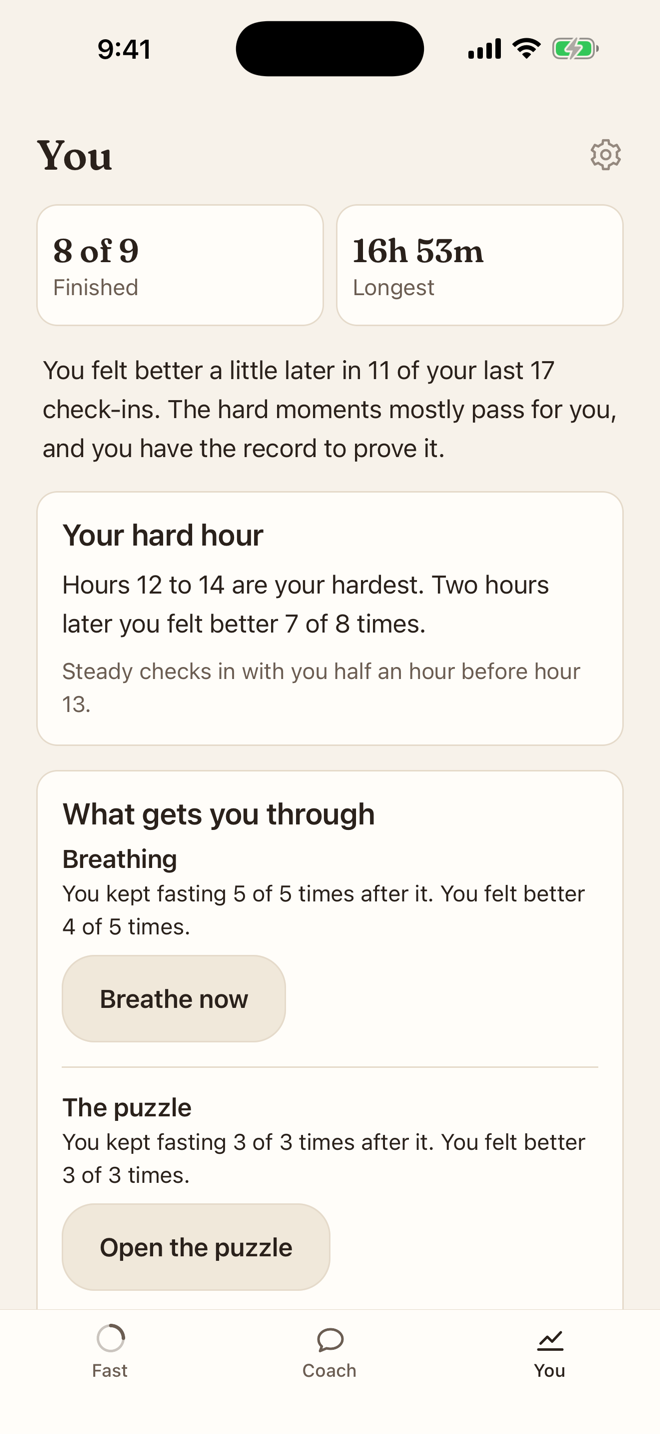
- Does the bad feeling pass? Rate it when it is bad and again two hours later. After a week you have your own evidence, which beats anyone telling you so.
Questions people ask
How do I start intermittent fasting as a beginner?
Start at 12 hours, not 16. Pick the eight-hour stretch of the day you would least like to give up food in, make everything outside it the fast, and keep the same hours for three days before you add any. Most people who quit in week one did not fail at fasting, they started two hours past where they should have.
Which fasting window is best for beginners?
12:12 for the first few days, then 14:10, then 16:8 if you want it. There is nothing special about 16 hours. A 14-hour window you finish four times a week teaches your body more than a 16-hour one you abandon at hour 13.
What can I drink while intermittent fasting?
Water, black coffee and plain tea, in any amount that suits you. A splash of milk is a few calories and matters far less than people think. Sugary drinks and juice end a fast in any sense that counts. Decide your list before the fast starts rather than negotiating with yourself at hour 13.
Will I lose weight in the first two weeks of intermittent fasting?
The scale usually drops in the first few days, and most of that is water rather than fat. Real change follows what you eat across the whole week and shows up over a month or two. If the first fortnight is judged on the scale, it will look either miraculous or pointless, and it is neither.
What happens if I break my fast early?
You ate earlier than planned, which is all. A 13-hour fast is a 13-hour fast, not a failed 16-hour one. The habit survives on what you do tomorrow, so a record that counts the shorter fast honestly is worth more than a streak that calls it a zero.
Get through the hard hours.
Steady is an intermittent fasting coach app for iPhone. It works out which hour tends to beat you, checks in just before it, and tells you to eat when you should. Your data never leaves your phone.
Free while it is in beta. Tell us what breaks, and we will let you know when Steady reaches the App Store.